

 Log In


July 18, 2026 | Writing
Farther vs Further Explained
Farther vs. Further Explained
The words farther and further are often used interchangeably, which makes them one of the most confusing word pairs in English. While many people use either word without causing confusion, there is a traditional difference that can make your writing clearer and more precise.
Understanding when to use farther and further will help you improve your grammar, especially in formal writing, academic work, and professional communication.
What Does "Farther" Mean?
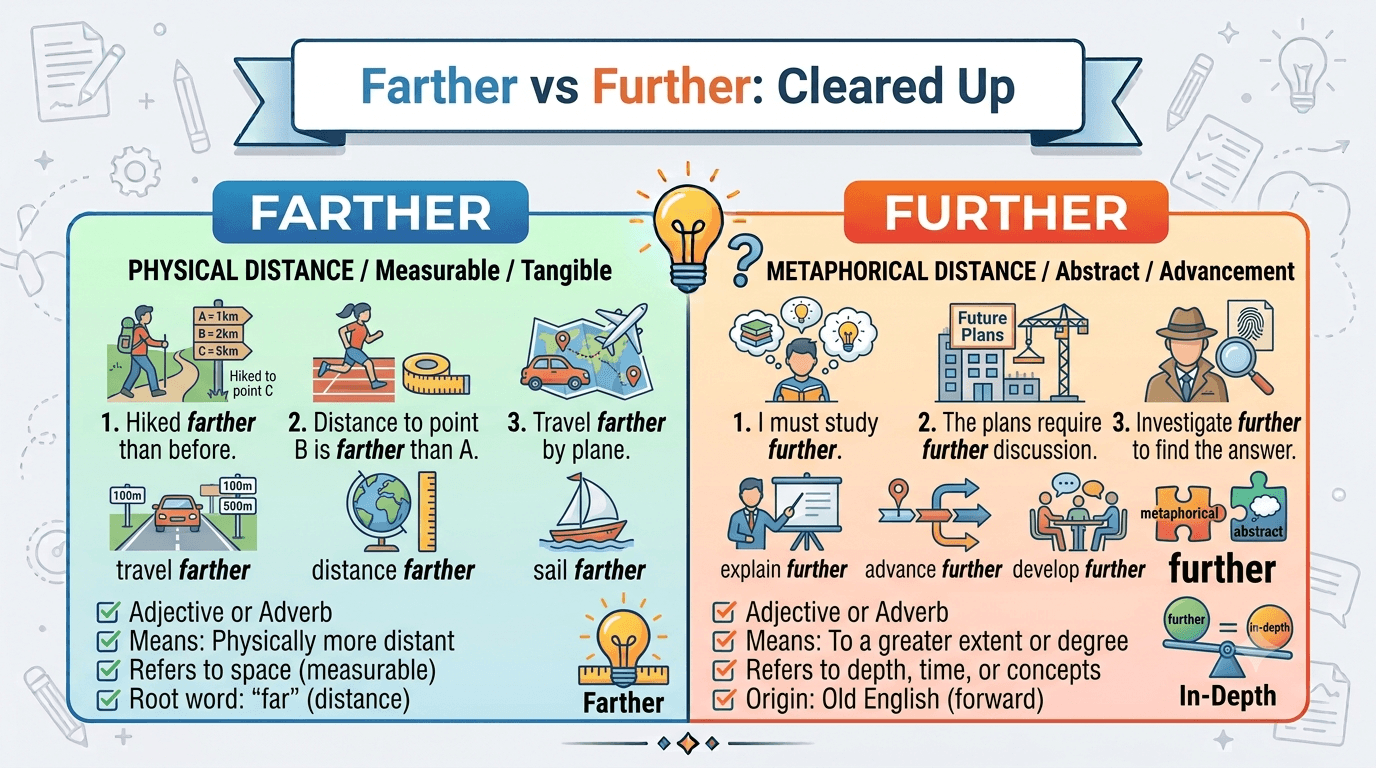
Farther refers to a physical distance. It describes something that is located at a greater measurable distance from another place or object.
Whenever you can measure the distance in miles, kilometers, meters, or other units, farther is usually the correct choice.
Examples:
The grocery store is farther than the pharmacy.
We walked farther than we planned.
The hotel is farther from the airport than I expected.
Their house is farther down the street.
What Does "Further" Mean?
Further usually refers to a figurative distance. It means additional, more, or to a greater degree rather than referring to physical space.
It is commonly used when talking about ideas, discussions, progress, education, research, or time.
Examples:
We need further information before making a decision.
She continued her education to further her career.
For further assistance, contact customer support.
The investigation requires further review.
The Main Difference
The easiest way to remember the distinction is this:
Farther relates to physical distance.
Further relates to additional information, greater progress, or figurative distance.
Although modern English sometimes allows the words to overlap, following this guideline makes your writing more accurate and professional.
An Easy Memory Trick
Notice that the word farther begins with far. This can remind you of places that are physically far away.
Think of further as meaning more or additional. If you're talking about extending an idea, adding information, or continuing a discussion, further is usually the right choice.
Examples of "Farther"
The beach is farther than we remembered.
She threw the ball farther than anyone else.
The next gas station is much farther along the highway.
We decided not to drive any farther because it was getting dark.
The mountain peak was farther away than it appeared.
Examples of "Further"
Please let me know if you need further clarification.
The company plans to conduct further research.
After further discussion, the team changed its decision.
We cannot proceed without further approval.
His training helped further his professional development.
When Both Words Can Work
In informal English, many native speakers use further for both physical and figurative distance.
For example:
We walked further down the road.
While many style guides recommend using farther for physical distance, this sentence is widely accepted in everyday conversation.
However, if you want your writing to follow traditional grammar rules, use farther for measurable distance and further for everything else.
Common Mistakes
Incorrect: We need farther information before deciding.
Correct: We need further information before deciding.
Incorrect: The library is further than the supermarket.
Preferred: The library is farther than the supermarket.
Incorrect: Please provide farther details.
Correct: Please provide further details.
Incorrect: They continued farther discussions.
Correct: They continued further discussions.
Tips for Remembering the Difference
If you're talking about miles, roads, buildings, or physical locations, choose farther.
If you're talking about ideas, explanations, education, research, or progress, choose further.
When you're unsure, ask yourself whether you can physically measure the distance. If you can, farther is probably correct.
Frequently Asked Questions
Can "further" refer to physical distance?
Yes. In modern English, many people use further for physical distance as well. However, traditional grammar recommends using farther when referring to measurable distance.
Which word is more common?
Further is generally more common because it has both literal and figurative uses. Farther is mostly limited to physical distance.
Will people understand me if I use the wrong one?
In most conversations, yes. However, using the correct word improves the accuracy and professionalism of your writing.
What's the easiest way to remember the rule?
Remember that farther contains the word "far," making it easy to associate with physical distance. Think of further whenever you mean additional, more, or beyond the current point in a discussion.
Conclusion
Although farther and further are closely related, knowing their traditional meanings can help you write with greater precision. Use farther when referring to measurable physical distance and further when talking about additional information, progress, ideas, or figurative distance. By applying this simple guideline, you'll avoid a common grammar mistake and communicate more clearly in both everyday and professional writing.
Recent Posts
July 18, 2026 | Writing
Everyday vs Every Day
Everyday vs. Every Day: What's the Difference? The English language contains many words and phrases that look almost identical but have diff...
Read MoreJuly 18, 2026 | Writing
Lose vs Loose: Why Peopl...
Lose vs. Loose: Why People Mix Them Up The words lose and loose are among the most commonly confused words in English. They look similar,...
Read MoreJuly 18, 2026 | Writing
Your vs You're: Com...
Your vs. You're: Common Grammar Errors Few grammar mistakes are as common as confusing your and you're. Since these two words sound exactly ...
Read MoreJuly 18, 2026 | Writing
Its vs It's Made Si...
Its vs. It's Made Simple Confusing its and it's is one of the most common grammar mistakes in English. Since the two words look almost ident...
Read MoreJuly 18, 2026 | Writing
Then vs Than: When to Us...
Then vs. Than: When to Use Each The words then and than are among the most commonly confused words in English. Since they look and sound sim...
Read More