

 Log In


July 18, 2026 | Writing
Its vs It's Made Simple
Its vs. It's Made Simple
Confusing its and it's is one of the most common grammar mistakes in English. Since the two words look almost identical, it's easy to use the wrong one without realizing it. However, they have completely different meanings, and understanding the difference can make your writing clearer and more professional.
The good news is that the rule is straightforward. Once you know what each word represents, choosing the correct one becomes much easier.
What Does "Its" Mean?
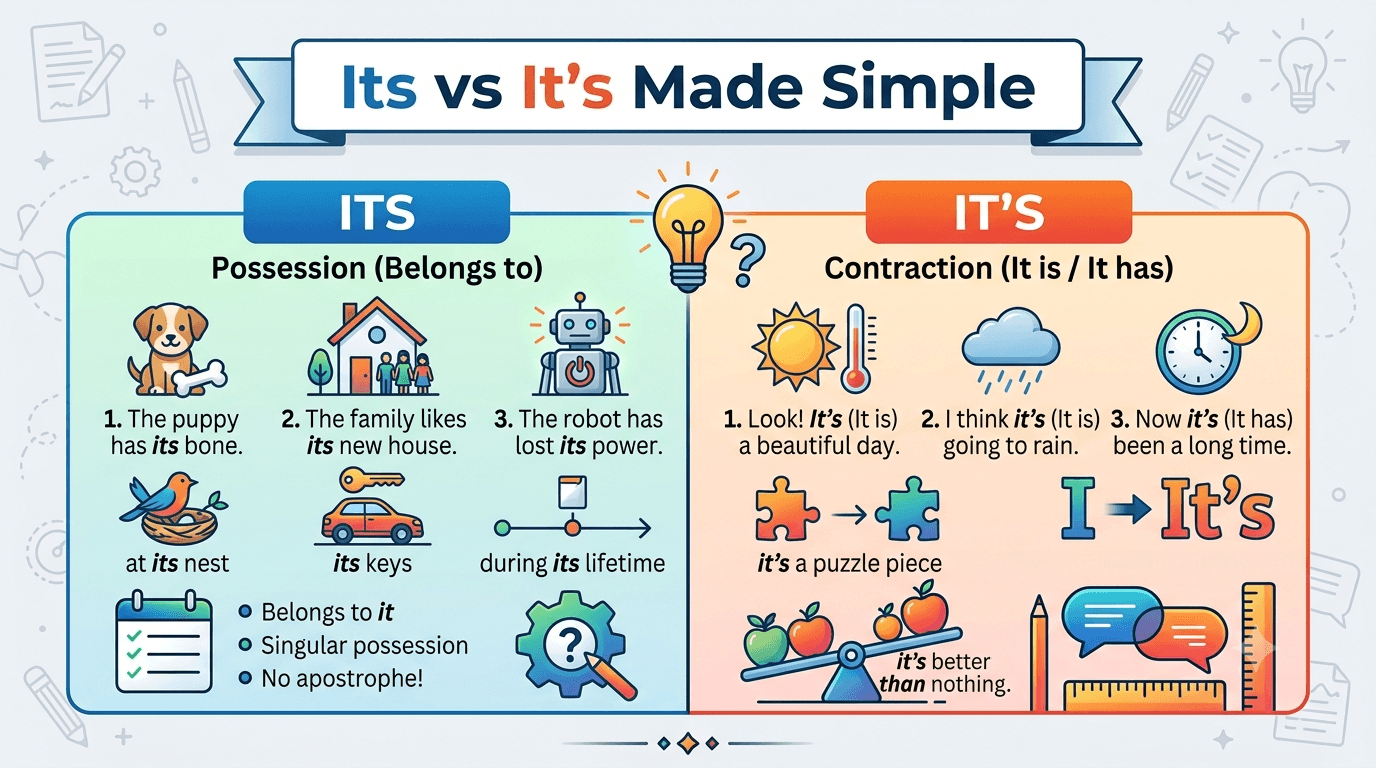
Its is a possessive pronoun. It shows that something belongs to or is associated with an animal, object, organization, or idea.
Unlike most possessive nouns, its does not use an apostrophe.
Examples:
The dog wagged its tail.
The company updated its website.
The tree lost its leaves during autumn.
The phone automatically installed its latest update.
In each example, its shows ownership or possession.
What Does "It's" Mean?
It's is a contraction. It stands for either it is or it has.
The apostrophe replaces the missing letter in the word is or indicates the shortened form of has.
Examples:
It's a beautiful afternoon.
It's been a busy week.
I think it's time to leave.
It's raining outside.
If you can replace it's with it is or it has and the sentence still makes sense, you've chosen the correct word.
The Simple Rule to Remember
Whenever you're unsure which word to use, replace it's with it is.
If the sentence still makes sense, use it's.
If it doesn't, use its.
Example:
It's getting late.
Replace it:
It is getting late.
The sentence still makes sense, so it's is correct.
Example:
The cat cleaned its paws.
Replace it:
The cat cleaned it is paws.
This doesn't make sense, so its is the correct choice.
Examples of "Its"
The company announced its annual results.
The bird built its nest in the tree.
Every country has its own traditions.
The software completed its installation automatically.
The restaurant is known for its friendly service.
Examples of "It's"
It's never too late to learn something new.
It's been an exciting journey.
I believe it's the right decision.
It's important to stay hydrated.
It's going to be a wonderful weekend.
Common Grammar Mistakes
Incorrect: The company changed it's logo.
Correct: The company changed its logo.
Incorrect: Its a beautiful day.
Correct: It's a beautiful day.
Incorrect: Every phone has it's own features.
Correct: Every phone has its own features.
Incorrect: Its been a long time.
Correct: It's been a long time.
Why People Get Confused
Most possessive nouns in English use an apostrophe, such as "the teacher's desk" or "the child's backpack." Because of this pattern, many people assume that its should also contain an apostrophe.
However, possessive pronouns are different. Words like his, hers, ours, yours, theirs, and its never use apostrophes to show possession.
Another reason for the confusion is that both words sound exactly the same when spoken. The mistake usually appears only in writing.
Tips to Avoid the Mistake
Before using it's, try replacing it with it is.
If the sentence still sounds natural, use it's.
If you're showing ownership or possession, use its.
Proofreading your writing before publishing or sending it can also help you catch this common error.
Frequently Asked Questions
Is "it's" always short for "it is"?
No. It can also mean it has, as in "It's been a wonderful experience."
Does "its" ever use an apostrophe?
No. The possessive pronoun its is always written without an apostrophe.
Why is this mistake so common?
Because most possessive nouns use apostrophes, many writers assume the same rule applies to its. In reality, possessive pronouns follow a different rule.
What's the easiest way to remember the difference?
Replace it's with it is. If the sentence still makes sense, use it's. Otherwise, choose its.
Conclusion
Although its and it's differ by only one apostrophe, they serve completely different purposes. Its shows ownership, while it's is a contraction for it is or it has. By remembering the simple replacement test and proofreading your writing carefully, you'll avoid one of the most common grammar mistakes in English and write with greater confidence.
Recent Posts
July 18, 2026 | Writing
Farther vs Further Expla...
Farther vs. Further Explained The words farther and further are often used interchangeably, which makes them one of the most confusing word ...
Read MoreJuly 18, 2026 | Writing
Everyday vs Every Day
Everyday vs. Every Day: What's the Difference? The English language contains many words and phrases that look almost identical but have diff...
Read MoreJuly 18, 2026 | Writing
Lose vs Loose: Why Peopl...
Lose vs. Loose: Why People Mix Them Up The words lose and loose are among the most commonly confused words in English. They look similar,...
Read MoreJuly 18, 2026 | Writing
Your vs You're: Com...
Your vs. You're: Common Grammar Errors Few grammar mistakes are as common as confusing your and you're. Since these two words sound exactly ...
Read MoreJuly 18, 2026 | Writing
Then vs Than: When to Us...
Then vs. Than: When to Use Each The words then and than are among the most commonly confused words in English. Since they look and sound sim...
Read More