

 Log In


July 18, 2026 | Writing
Lose vs Loose: Why People Mix Them Up
Lose vs. Loose: Why People Mix Them Up
The words lose and loose are among the most commonly confused words in English. They look similar, sound somewhat alike, and differ by only one letter. As a result, many people accidentally use one when they mean the other, especially when writing quickly.
Although the spelling difference is small, the meanings are completely different. Understanding how each word is used will help you avoid a common grammar mistake and improve the accuracy of your writing.
What Does "Lose" Mean?
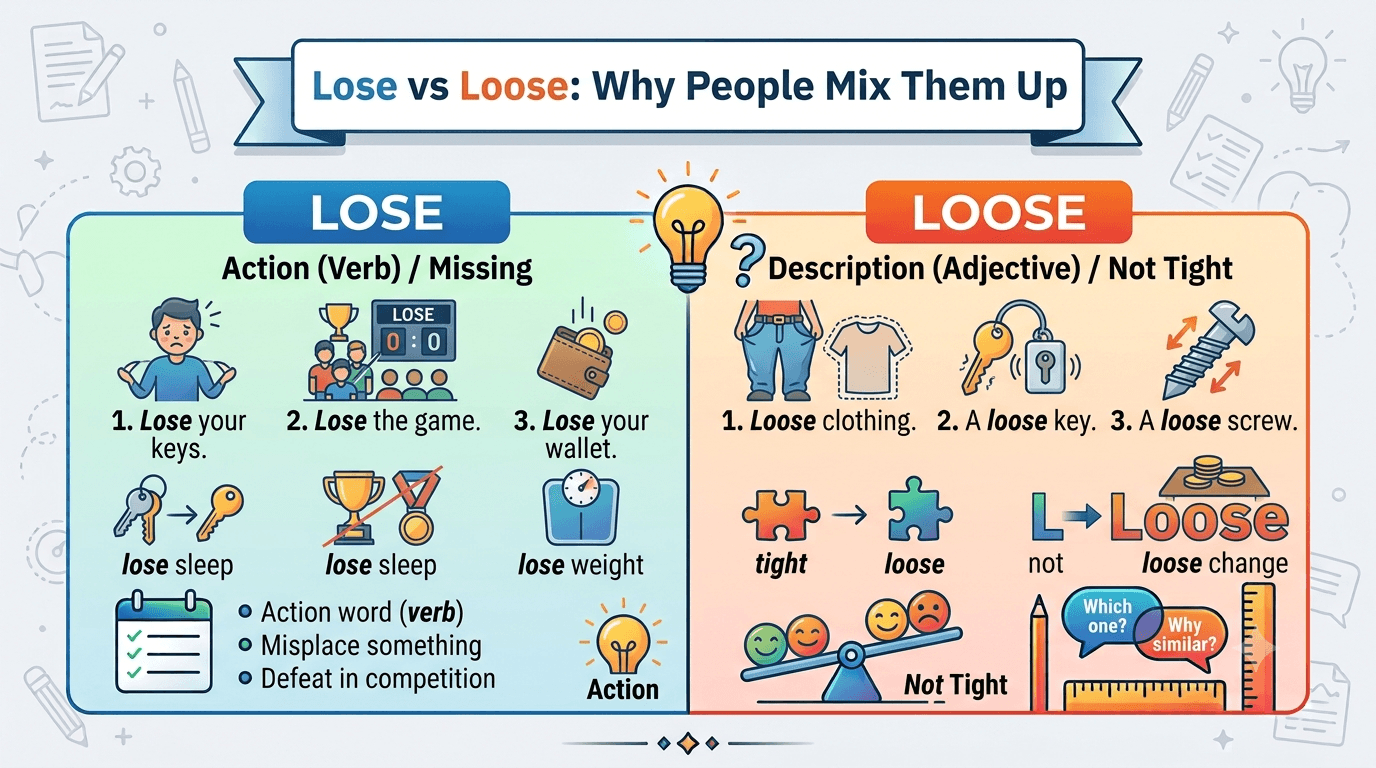
Lose is a verb. It means to no longer have something, to fail to win, or to become unable to find something.
Examples:
Don't lose your keys.
Our team hopes they won't lose the final match.
You could lose important files if you don't save your work.
She doesn't want to lose her passport while traveling.
In each of these examples, lose describes an action.
What Does "Loose" Mean?
Loose is usually an adjective. It describes something that is not tight, firmly attached, or securely fastened.
Examples:
The screw is loose.
These shoes feel too loose.
The dog's collar is loose and needs to be tightened.
The handle became loose after years of use.
Here, loose describes the condition of an object.
The Key Difference
The easiest way to tell these words apart is to remember what they describe.
Lose is an action. It means to misplace something or fail to win.
Loose describes something that is not tight or securely attached.
If you're talking about an action, you probably need lose. If you're describing the condition of an object, you probably need loose.
An Easy Memory Trick
A simple way to remember the difference is to look at the number of "o" letters.
Loose has two "o" letters, which can remind you of extra space. Something that is loose has room to move.
Lose has only one "o" and refers to losing something or not winning.
This small spelling clue can help you choose the correct word while writing.
Examples of "Lose"
Please don't lose your wallet.
If we don't practice, we might lose the game.
I always lose my sunglasses during summer.
She was worried she would lose her job.
You'll lose valuable time if you leave late.
Examples of "Loose"
The wheel feels loose.
My jacket has become loose after losing weight.
The knot came loose during the hike.
The cabinet door is loose and needs repairing.
He prefers wearing loose clothing in hot weather.
Why People Mix Them Up
There are several reasons these words are frequently confused.
First, their spellings are almost identical. The only difference is an extra "o" in loose.
Second, their pronunciations are similar enough that many learners don't immediately notice the distinction.
Finally, both words are correctly spelled English words, so spell checkers may not detect the mistake if the wrong one is used.
Common Mistakes to Avoid
Incorrect: I always loose my phone.
Correct: I always lose my phone.
Incorrect: My backpack strap is lose.
Correct: My backpack strap is loose.
Incorrect: We don't want to loose the competition.
Correct: We don't want to lose the competition.
Incorrect: These pants are too lose.
Correct: These pants are too loose.
Tips for Remembering the Difference
Think about whether you're describing an action or an object.
If someone can lose something or lose a game, use lose.
If an object isn't tight, use loose.
Taking a moment to proofread your writing can also help you catch this common mistake before publishing or sending your work.
Frequently Asked Questions
Is "lose" always a verb?
Yes. In everyday English, lose is used as a verb. The related noun is loss.
Can "loose" be used as a verb?
Yes, but it's uncommon. As a verb, loose means to release or set free. Most people encounter it as an adjective meaning "not tight."
Why doesn't spell check catch this mistake?
Because both lose and loose are valid English words. Spell checkers often can't determine which word fits the sentence.
What's the easiest way to remember the difference?
Remember that loose has two "o" letters, like something with extra room. Lose has one "o" and means to misplace something or fail to win.
Conclusion
Although lose and loose look similar, they have very different meanings. Lose is an action that means to misplace something or fail to win, while loose describes something that isn't tight. By remembering the simple spelling trick and reviewing your writing carefully, you'll be able to use both words correctly and avoid one of the most common mistakes in English.
Recent Posts
July 18, 2026 | Writing
Farther vs Further Expla...
Farther vs. Further Explained The words farther and further are often used interchangeably, which makes them one of the most confusing word ...
Read MoreJuly 18, 2026 | Writing
Everyday vs Every Day
Everyday vs. Every Day: What's the Difference? The English language contains many words and phrases that look almost identical but have diff...
Read MoreJuly 18, 2026 | Writing
Your vs You're: Com...
Your vs. You're: Common Grammar Errors Few grammar mistakes are as common as confusing your and you're. Since these two words sound exactly ...
Read MoreJuly 18, 2026 | Writing
Its vs It's Made Si...
Its vs. It's Made Simple Confusing its and it's is one of the most common grammar mistakes in English. Since the two words look almost ident...
Read MoreJuly 18, 2026 | Writing
Then vs Than: When to Us...
Then vs. Than: When to Use Each The words then and than are among the most commonly confused words in English. Since they look and sound sim...
Read More