

 Log In


July 18, 2026 | Writing
Then vs Than: When to Use Each
Then vs. Than: When to Use Each
The words then and than are among the most commonly confused words in English. Since they look and sound similar, many people accidentally use one when they mean the other. Although the mistake is easy to make, these words have completely different meanings and are used in different situations.
Learning the difference between then and than will help you write more accurately, improve your grammar, and avoid one of the most frequent errors in English.
What Does "Then" Mean?
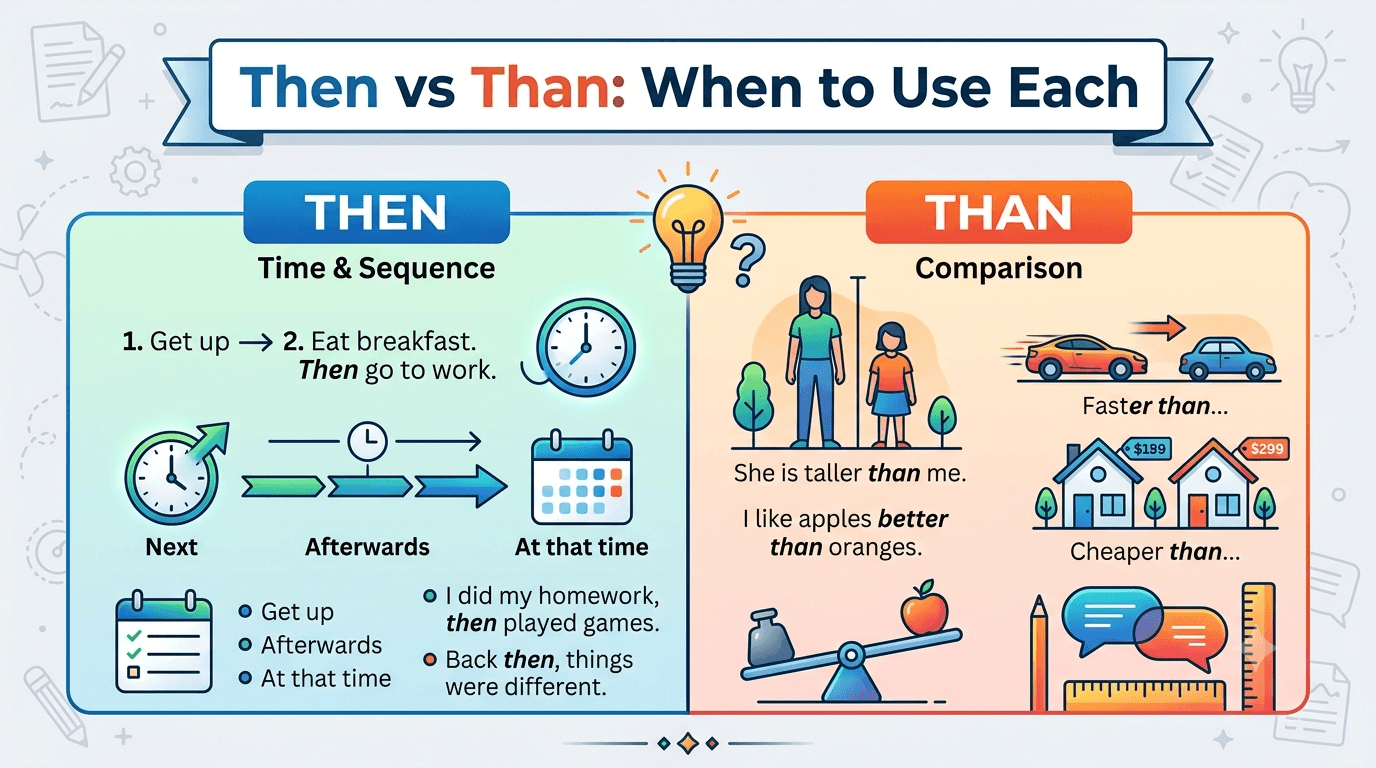
Then usually relates to time or the order of events. It often means "next," "afterward," or "at that time."
It helps show what happens first and what happens afterward.
Examples:
Finish your homework, then you can watch television.
We had dinner, then we went for a walk.
Back then, life was much simpler.
If it starts raining, then we'll stay indoors.
What Does "Than" Mean?
Than is used to make comparisons. It shows the difference between two or more people, objects, places, ideas, or actions.
Whenever you're comparing something, than is usually the correct choice.
Examples:
This book is more interesting than the last one.
She is taller than her brother.
Learning online is easier than many people expect.
He arrived earlier than we anticipated.
The Key Difference
The difference between these words is simple once you understand their purpose.
Use then when talking about time, sequence, or what happens next.
Use than when making a comparison between two or more things.
If you're discussing the order of events, choose then. If you're comparing people, objects, or ideas, choose than.
An Easy Memory Trick
A simple way to remember the difference is to associate each word with its meaning.
Think of then as referring to time or the next event.
Think of than whenever you're making a comparison.
Before writing, ask yourself whether you're comparing something or describing what happens next. The answer will help you choose the correct word.
Examples of "Then"
First wash your hands, then prepare the ingredients.
She graduated from college and then started her career.
I'll finish this task, then I'll call you.
Back then, people relied more on printed maps.
Complete the registration, then check your email.
Examples of "Than"
My new laptop is faster than my old one.
Walking is healthier than driving short distances.
He knows more about history than I do.
The blue shirt is cheaper than the black one.
This puzzle is harder than it looks.
Using Both Words in the Same Sentence
Sometimes both words appear in the same sentence because they perform different jobs.
Finish your assignment, then you'll have more free time than you expected.
She worked harder than anyone else, then celebrated her success.
We compared several restaurants, then chose one that was better than the others.
These examples show that then indicates the order of events, while than introduces a comparison.
Common Grammar Mistakes
Incorrect: She is taller then her sister.
Correct: She is taller than her sister.
Incorrect: We ate dinner than watched a movie.
Correct: We ate dinner, then watched a movie.
Incorrect: This test is easier then the previous one.
Correct: This test is easier than the previous one.
Incorrect: Finish your work than go home.
Correct: Finish your work, then go home.
Tips to Avoid the Mistake
Ask yourself whether you're talking about time or making a comparison.
If the sentence describes what happens next, use then.
If the sentence compares two things, use than.
Reading your writing carefully before publishing or sending it can help you catch these small but important mistakes.
Frequently Asked Questions
Can "then" and "than" ever be used interchangeably?
No. Although they are similar in spelling and pronunciation, they have different meanings and cannot replace one another.
Why do people confuse these words?
They look almost identical and sound very similar, especially in everyday conversation. Most mistakes occur while writing rather than speaking.
How can I remember the difference?
Think of then when talking about time and sequence. Think of than whenever you're comparing two or more things.
Do native English speakers make this mistake?
Yes. Even experienced writers occasionally confuse these words when typing quickly, which is why proofreading is always helpful.
Conclusion
The difference between then and than is easy to remember once you know their purpose. Use then when referring to time or the order of events, and use than when making comparisons. By applying this simple rule and reviewing your writing carefully, you'll avoid one of the most common grammar mistakes and communicate with greater clarity and confidence.
Recent Posts
July 18, 2026 | Writing
Farther vs Further Expla...
Farther vs. Further Explained The words farther and further are often used interchangeably, which makes them one of the most confusing word ...
Read MoreJuly 18, 2026 | Writing
Everyday vs Every Day
Everyday vs. Every Day: What's the Difference? The English language contains many words and phrases that look almost identical but have diff...
Read MoreJuly 18, 2026 | Writing
Lose vs Loose: Why Peopl...
Lose vs. Loose: Why People Mix Them Up The words lose and loose are among the most commonly confused words in English. They look similar,...
Read MoreJuly 18, 2026 | Writing
Your vs You're: Com...
Your vs. You're: Common Grammar Errors Few grammar mistakes are as common as confusing your and you're. Since these two words sound exactly ...
Read MoreJuly 18, 2026 | Writing
Its vs It's Made Si...
Its vs. It's Made Simple Confusing its and it's is one of the most common grammar mistakes in English. Since the two words look almost ident...
Read More