

 Log In


July 18, 2026 | Writing
Your vs You're: Common Grammar Errors
Your vs. You're: Common Grammar Errors
Few grammar mistakes are as common as confusing your and you're. Since these two words sound exactly the same, many people accidentally use the wrong one when writing emails, text messages, essays, or social media posts. While readers can often understand the intended meaning, using the correct word makes your writing clearer and more professional.
The good news is that the difference between your and you're is easy to understand. Once you learn one simple rule, you'll be able to use them correctly every time.
What Does "Your" Mean?
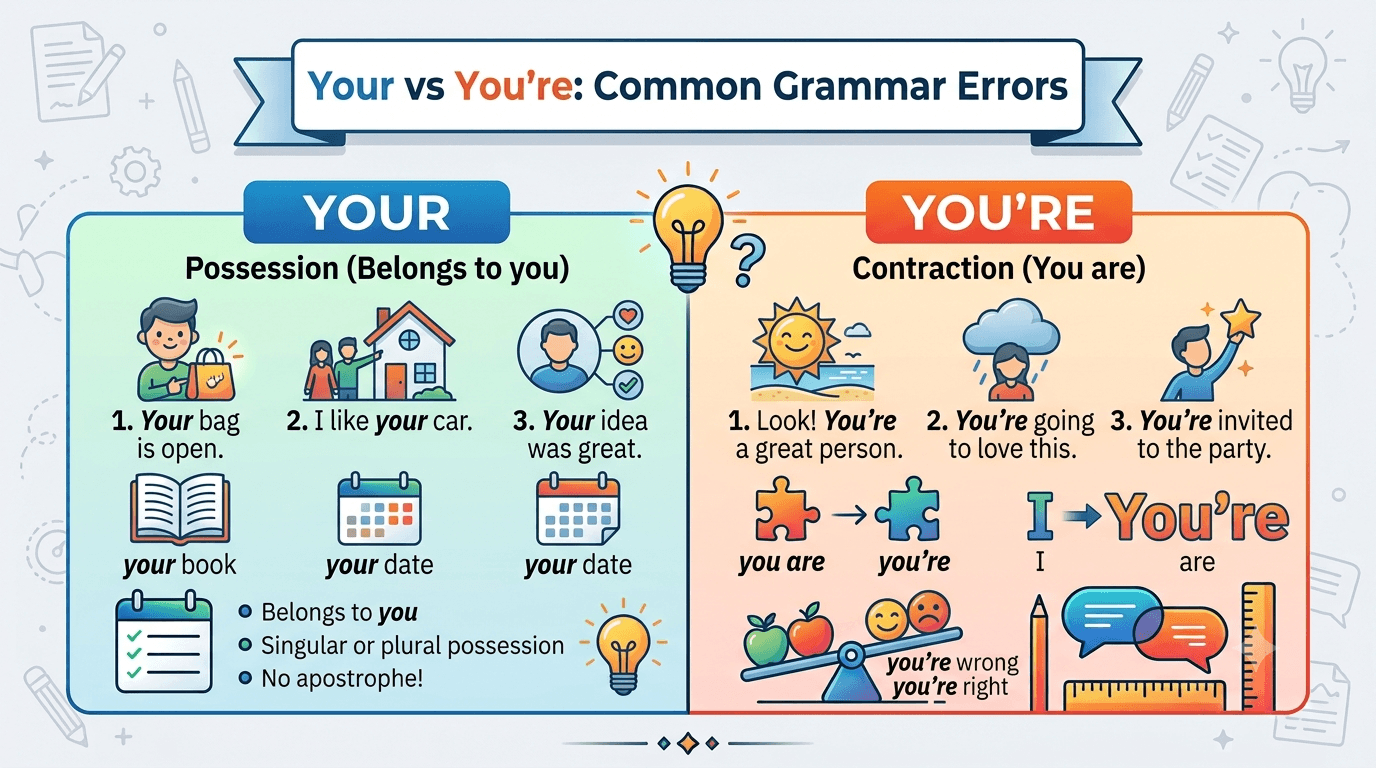
Your is a possessive adjective. It shows that something belongs to the person you are talking to.
It always comes before a noun because it describes ownership.
Examples:
Your backpack is on the table.
Please remember to bring your passport.
Your opinion is important.
I really like your new haircut.
In each sentence, your shows possession.
What Does "You're" Mean?
You're is a contraction of you are. The apostrophe replaces the missing letter "a" in the word "are."
If you can replace you're with you are and the sentence still makes sense, then you're using the correct word.
Examples:
You're doing an excellent job.
I think you're ready for the exam.
You're welcome to join us.
If you're tired, you should get some rest.
The Simple Rule to Remember
When you're unsure which word to use, replace you're with you are.
If the sentence still sounds correct, use you're.
If it doesn't make sense, use your.
Example:
You're my best friend.
Replace it:
You are my best friend.
The sentence still works, so you're is correct.
Example:
Your phone is ringing.
Replace it:
You are phone is ringing.
This doesn't make sense, so your is the correct choice.
Examples of "Your"
Your car is parked outside.
Have you finished your homework?
Your smile made everyone's day better.
Don't forget your umbrella.
Your ideas helped improve the project.
Examples of "You're"
You're always welcome here.
You're learning English very quickly.
I believe you're making the right decision.
You're going to enjoy this book.
You're one step closer to your goal.
Common Grammar Mistakes
Incorrect: Your welcome.
Correct: You're welcome.
Incorrect: I think your right.
Correct: I think you're right.
Incorrect: You're laptop is on the desk.
Correct: Your laptop is on the desk.
Incorrect: Is this you're notebook?
Correct: Is this your notebook?
Why People Mix Them Up
The main reason is that your and you're are homophones. Homophones are words that have the same pronunciation but different meanings and spellings.
When speaking, there is no audible difference between the two words. The confusion usually happens during writing, especially when typing quickly or relying on autocorrect. Since both words are correctly spelled, spell-check tools often fail to identify the mistake.
Tips to Avoid the Mistake
Always pause for a moment before writing either word.
If you're talking about ownership, choose your.
If you mean you are, choose you're.
Reading your sentence aloud can also help you notice whether the contraction makes sense.
With regular practice, choosing the correct word will become second nature.
Frequently Asked Questions
Is "you're" always short for "you are"?
Yes. The contraction you're always means you are.
Can "your" ever replace "you're"?
No. Your only shows possession and cannot replace the contraction you're.
Why doesn't spell check catch this mistake?
Because both words are correctly spelled. Spell-check software often cannot determine whether the correct word has been used based on context.
Do native English speakers confuse these words?
Yes. This is one of the most common grammar mistakes made by native speakers, especially in informal writing such as text messages and social media posts.
Conclusion
The difference between your and you're is simple once you understand their meanings. Your shows ownership, while you're is a shortened form of you are. A quick replacement test can help you choose the correct word whenever you're unsure. By paying attention to this small detail, you'll improve your grammar, make your writing more professional, and avoid one of the most common errors in English.
Recent Posts
July 18, 2026 | Writing
Farther vs Further Expla...
Farther vs. Further Explained The words farther and further are often used interchangeably, which makes them one of the most confusing word ...
Read MoreJuly 18, 2026 | Writing
Everyday vs Every Day
Everyday vs. Every Day: What's the Difference? The English language contains many words and phrases that look almost identical but have diff...
Read MoreJuly 18, 2026 | Writing
Lose vs Loose: Why Peopl...
Lose vs. Loose: Why People Mix Them Up The words lose and loose are among the most commonly confused words in English. They look similar,...
Read MoreJuly 18, 2026 | Writing
Its vs It's Made Si...
Its vs. It's Made Simple Confusing its and it's is one of the most common grammar mistakes in English. Since the two words look almost ident...
Read MoreJuly 18, 2026 | Writing
Then vs Than: When to Us...
Then vs. Than: When to Use Each The words then and than are among the most commonly confused words in English. Since they look and sound sim...
Read More