

 Log In


July 18, 2026 | Writing
Everyday vs Every Day
Everyday vs. Every Day: What's the Difference?
The English language contains many words and phrases that look almost identical but have different meanings. One common example is everyday and every day. The only visible difference is a space, but that small detail changes how each one is used in a sentence.
Many writers accidentally use these terms interchangeably, leading to unnecessary grammar mistakes. Fortunately, once you understand the difference, it's easy to choose the correct one every time.
What Does "Everyday" Mean?
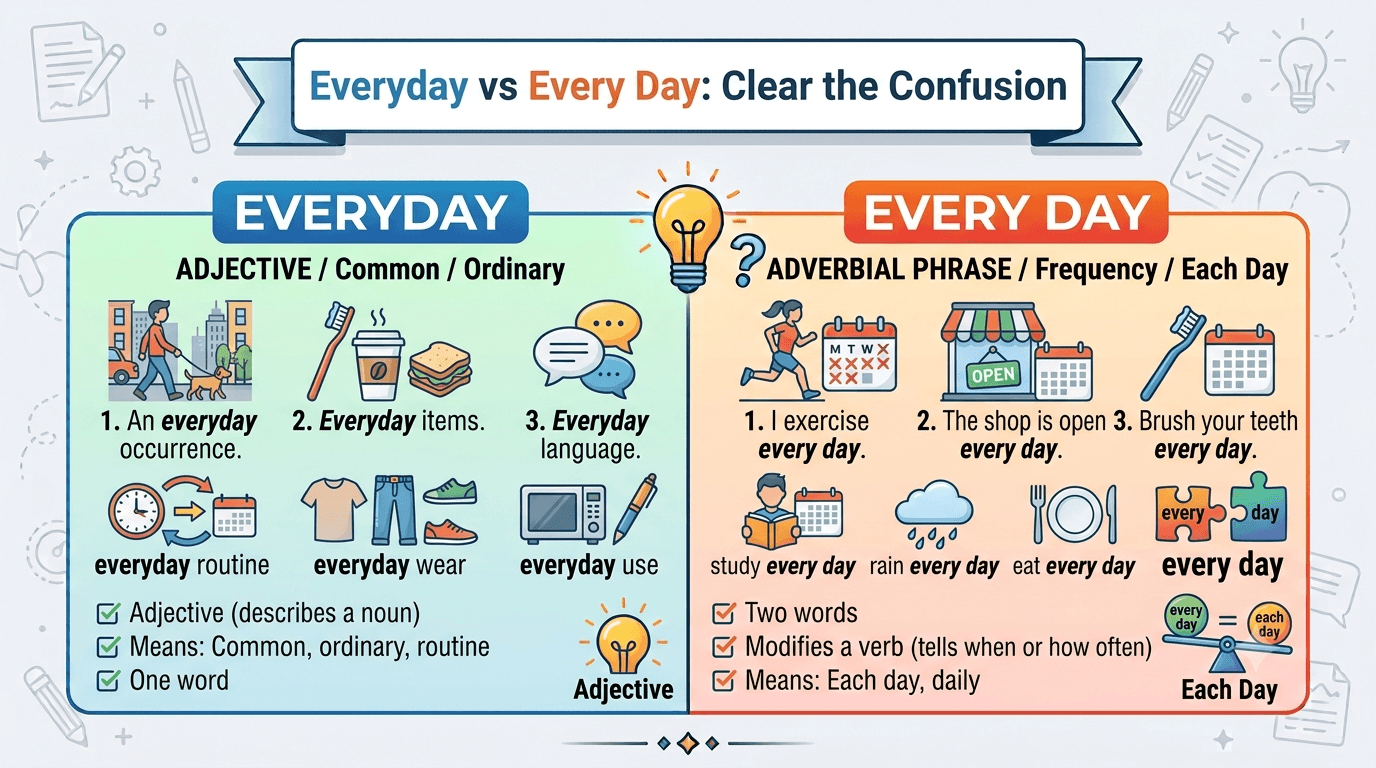
Everyday is a single word that functions as an adjective. It describes something that is ordinary, common, or regularly used. Because it is an adjective, it appears before a noun.
Think of everyday as describing something that is part of normal life rather than something special or unusual.
Examples:
She prefers comfortable everyday clothing.
Cooking is an everyday activity in most households.
The laptop is designed for everyday use.
Good communication is an everyday skill.
What Does "Every Day" Mean?
Every day is a two-word phrase that means each day or daily. Instead of describing a noun, it tells you how often something happens.
Examples:
I read for thirty minutes every day.
They exercise every day before work.
She drinks plenty of water every day.
We learn something new every day.
The Key Difference
The easiest way to remember the difference is by understanding each word's role.
Everyday describes a noun.
Every day describes how often an action happens.
Although they sound exactly the same when spoken, they perform different jobs in a sentence.
A Simple Memory Trick
If you're unsure which form to use, replace every day with each day.
If the sentence still makes sense, then the two-word version is correct.
Example:
I go for a walk every day.
I go for a walk each day.
The meaning remains the same, so every day is correct.
Now look at this example:
These are my everyday shoes.
Saying "These are my each day shoes" doesn't make sense, so everyday is the correct choice.
Examples of "Everyday"
Technology has become an everyday part of modern life.
He carries an everyday backpack for work.
These everyday habits can improve your health.
The store sells everyday household products.
Simple acts of kindness can brighten everyday life.
Examples of "Every Day"
She studies English every day.
We walk our dog every day.
The café opens every day at 8 a.m.
He practices the piano every day.
I check my email every day before work.
Common Mistakes to Avoid
Incorrect: I drink coffee everyday.
Correct: I drink coffee every day.
Incorrect: These are my every day shoes.
Correct: These are my everyday shoes.
Incorrect: Reading is an every day habit.
Correct: Reading is an everyday habit.
Incorrect: We exercise everyday after work.
Correct: We exercise every day after work.
Why This Mistake Is So Common
Since both expressions sound exactly the same when spoken, it's impossible to tell which one is being used without seeing it written down. Many people learn English by listening before writing, so they naturally assume both forms are interchangeable.
In addition, autocorrect tools don't always catch the mistake because both versions are correctly spelled words. That's why proofreading remains an important step when writing emails, essays, blog posts, or professional documents.
Tips for Remembering the Difference
Remember that everyday is an adjective describing something ordinary.
Remember that every day means each day or daily.
If you can replace the phrase with "each day," choose every day.
If you're describing a noun, choose everyday.
Reading your writing aloud can also help you notice whether you're talking about frequency or describing something.
Frequently Asked Questions
Is "everyday" always one word?
Yes. When it means ordinary or commonly used, it is always written as one word.
Can "every day" start a sentence?
Yes. For example: "Every day, she spends an hour reading."
How do I know which one to use?
Ask yourself whether you're describing something or talking about how often something happens. If it's about frequency, use every day. If it describes a noun, use everyday.
Do native English speakers confuse these words?
Yes. Because they sound identical, even native speakers occasionally make this mistake, especially when typing quickly.
Conclusion
Although the difference between everyday and every day is only a single space, understanding their meanings can significantly improve your writing. Use everyday to describe something ordinary or commonly used, and use every day when referring to something that happens daily. By remembering this simple rule and proofreading your work carefully, you'll avoid one of the most common grammar mistakes in English.
Recent Posts
July 18, 2026 | Writing
Farther vs Further Expla...
Farther vs. Further Explained The words farther and further are often used interchangeably, which makes them one of the most confusing word ...
Read MoreJuly 18, 2026 | Writing
Lose vs Loose: Why Peopl...
Lose vs. Loose: Why People Mix Them Up The words lose and loose are among the most commonly confused words in English. They look similar,...
Read MoreJuly 18, 2026 | Writing
Your vs You're: Com...
Your vs. You're: Common Grammar Errors Few grammar mistakes are as common as confusing your and you're. Since these two words sound exactly ...
Read MoreJuly 18, 2026 | Writing
Its vs It's Made Si...
Its vs. It's Made Simple Confusing its and it's is one of the most common grammar mistakes in English. Since the two words look almost ident...
Read MoreJuly 18, 2026 | Writing
Then vs Than: When to Us...
Then vs. Than: When to Use Each The words then and than are among the most commonly confused words in English. Since they look and sound sim...
Read More